

In early February, Congress passed the Consolidated Appropriations Act of 2026 (CAA ‘26), a government funding bill enacting extensive federal changes to pharmacy benefit manager (PBM) contracting and oversight. One day later, the Federal Trade Commission (FTC) announced a landmark settlement with Express Scripts, the first of the big three PBMs to reach a settlement with the agency. A settlement with CVS Caremark followed in July, and a settlement with Optum Rx is expected shortly.
Together, these developments will shift how plans evaluate and contract for pharmacy benefit services in 2027 and beyond. Although finer details and the full impact for plan sponsors will become clearer as implementing regulations are proposed and finalized, here are the key takeaways for plan sponsors:
Consolidated Appropriations Act, 2026
The CAA ’26 was signed into law on February 3, 2026. Its reforms focus on rebate pass-through requirements and increased transparency through detailed, standardized reporting from PBMs and expanded application of existing service provider disclosure requirements.
Effective date: The CAA ‘26 is effective for plan years beginning on or after August 3, 2028, (or January 1, 2029, for calendar-year plans).
Requirements:
- Pass-through of rebates: PBMs must pass through 100% of manufacturer compensation, including rebates, fees and other remuneration to the plan sponsor. This includes remuneration from group purchasing organizations (GPOs) and rebate aggregators in connection with the plan’s drug utilization or spending. PBMs may retain transparent and quantifiable bona fide service fees.
- PBM reporting to plans: PBMs must provide standard reporting to plans every six months for each covered drug as well as total plan summary information. Reporting must include the following:
- All compensation received by the PBM from the plan.
- All compensation paid to pharmacies by the PBM.
- Any spread collected between these two amounts.
- Total rebates, fees and other remuneration received by the plan and PBM.
- The amount the PBM paid to brokers or consultants for referrals.
- Rationale for the formulary placement of certain high-cost drugs.
- Any benefit design that favors PBM-affiliated pharmacies.
- Plan notice to participants: Plan sponsors must annually notify participants and beneficiaries of the PBMs’ reporting obligations and provide relevant plan summary data upon request.
Next steps: The CAA ‘26 requires the Department of Health and Human Services, the Department of Labor (DOL) and the Department of the Treasury (collectively, the departments) to issue final regulations within 18 months after passage: August 3, 2027. These rules will clarify definitions and establish standardized processes for rebate remittance, audits and disclosures.
Anticipated impact: As a result of the changes, we anticipate PBMs will assume less financial risk and shift to fixed, fee-for-service arrangements. There will also be less reliance on traditional per-brand rebate guarantees as PBMs will be required to pass through 100% of the value they receive from manufacturers, including GPO fees and other fees tied to drug utilization. Since these fees can no longer be structured as a percentage of rebates, we expect PBMs to reallocate their compensation through alternative fees, such as per-claim or per-member fees. Enhanced drug-level rebate reporting will also provide greater visibility into net drug costs and give plan sponsors the ability to validate that the required pass-through is occurring.
Federal Trade Commission settlements
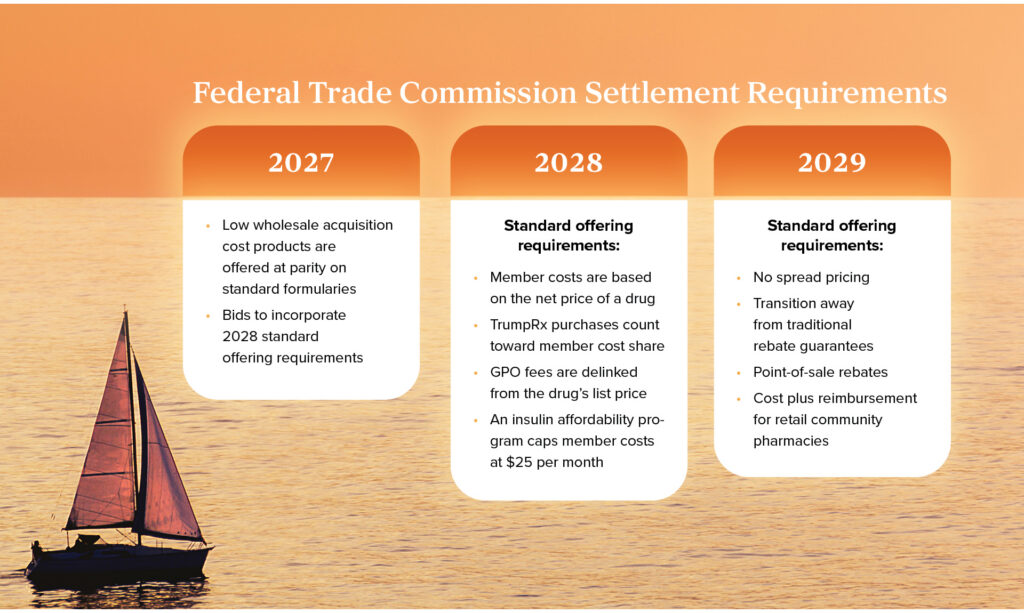
The FTC settlements mark the culmination of the insulin-pricing action the FTC brought in 2024 against the big three PBMs. Under the voluntary settlements, the PBMs have agreed to make the terms negotiated with the FTC available as a standard offering to plan sponsors beginning in 2027. The terms of the Express Scripts and CVS Caremark settlements are broadly aligned and do not materially differ from each other.
Effective date: All bid or request for proposal responses after January 1, 2027, will incorporate the terms of the standard offering. Various terms have staggered effective dates for applicability in 2028 and 2029.
Requirements:
Overall, these settlement terms reinforce several themes from the CAA ’26, including a broader market shift to net cost pricing models and removing list price-based compensation. Consistent with the consumer protection goals of the FTC, the settlement aims to shift value to the point of sale and reduce out-of-pocket costs for members.
Documentation process: While the big three PBMs must lead with the terms of the standard offering, the standard offering is not mandatory and plan sponsors can select an alternative model or arrangement. To deviate from the standard offering, plan sponsors must sign a template acknowledgment prepared by the FTC, stating in writing that they were made aware of the standard offering. The acknowledgment form is available now on the final page of the settlement.
Plan sponsors may include commentary with the acknowledgment explaining their reason for signing. This is an important consideration as plans look to document their fiduciary due diligence and demonstrate that their decision-making process was reasonable. The form will remain on file with the PBM and will not be sent to federal regulators.
Anticipated impacts: As plan sponsors prepare to evaluate the standard offering for post 1/1/27 bids, they should expect to see lower quarterly rebate revenue as manufacturer rebates are applied at the point of sale. This could increase overall plan costs, even as member out-of-pocket costs decline due to the savings passing directly to participants at the pharmacy counter. Cash flow and funding are also important factors to evaluate as there is typically a cost associated with implementing point of sale rebates due to the upfront funding adjustments that occur while waiting on manufacturer rebate payments. Plan sponsors should consider the total value of the arrangement, including rebates, point-of-sale discounts and all administrative and service fees when assessing the financial impact of the settlements.
Department of Labor rule pending final review
The White House has just finished reviewing a final rule that could require extensive PBM disclosures even sooner than the CAA ‘26 effective date. The same week the CAA ‘26 was enacted, the DOL released a proposed rule implementing stricter disclosure requirements for PBMs and covered service providers under ERISA §408(b)(2). There is significant overlap between the DOL’s proposed rule and the CAA reporting requirements. However, the DOL reporting would be required much sooner, 60 days after publication of the final rule (which is expected to be finalized by the end of 2026). Stakeholders have encouraged the DOL to withdraw its rule and align the requirements with the CAA ‘26 reporting so that vendors and plan sponsors do not have to report, digest and operationalize substantially the same information twice.
Final thoughts
While the CAA ‘26 and FTC standard offering will alter how PBMs are compensated and arm plan sponsors with more information, greater transparency does not automatically guarantee lower costs. As plan sponsors prepare to evaluate new offerings and pricing models beyond traditional per-brand guarantees, the overall financial value to the plan remains an important consideration.
These developments will continue to evolve as PBMs determine how to comply with and operationalize these requirements, and the compliance approaches may vary across PBMs. Plan sponsors should work closely with their consultants and trusted pharmacy advisors to understand how these changes impact their specific plan, evaluate the full financial impact of emerging pricing models and use that analysis to inform a prudent, well-documented decision-making process.
For more information, please contact Madison Connor at [email protected].


