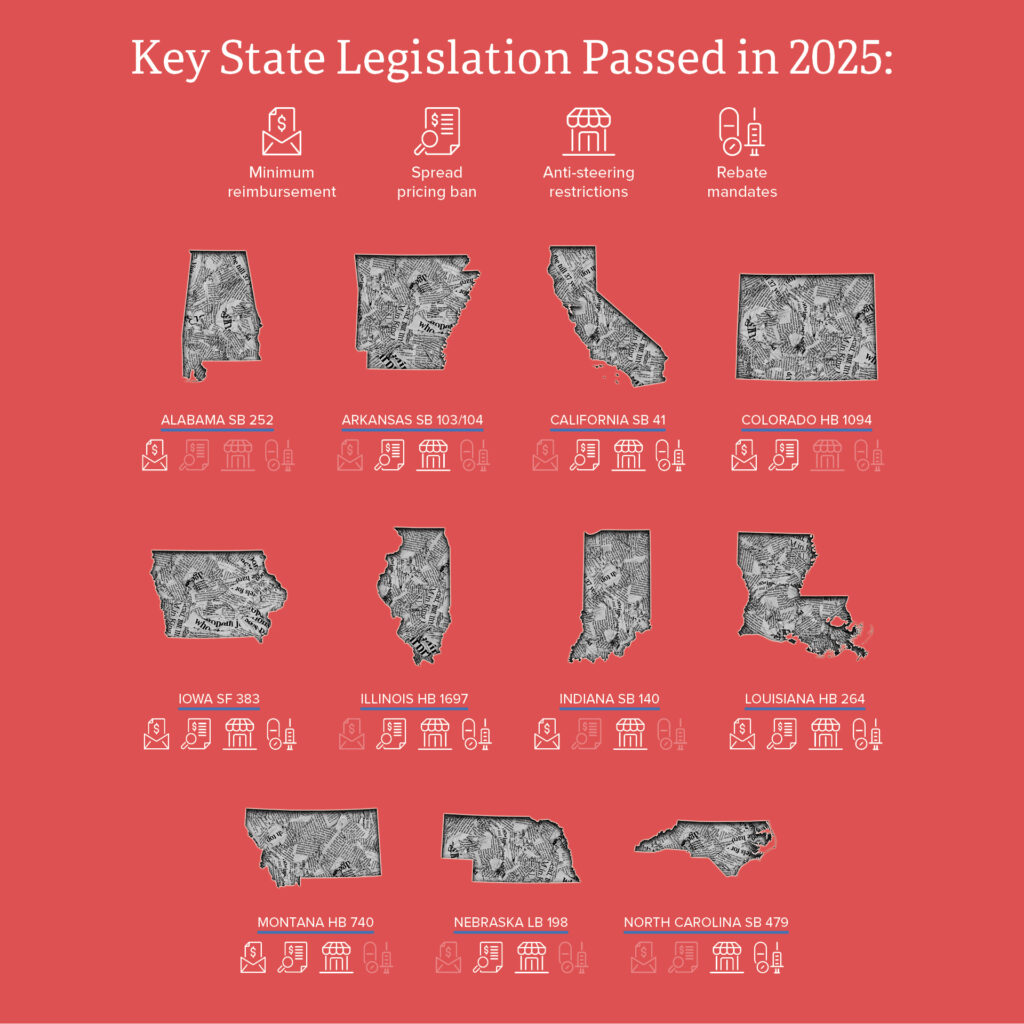
This past year, states continued to pass comprehensive pharmacy benefit legislation focused on pharmacy reimbursements, network composition, patient affordability and market transparency. Many of these laws ban spread pricing, mandate higher reimbursements coupled with increased dispensing fees ranging from $10-$15 for independent pharmacies and prohibit exclusive or narrow pharmacy networks that incentivize participants to use in-network pharmacies.
Some notable, first-of-their-kind laws included Illinois HB 1697, which imposes a $15 covered life assessment on pharmacy benefit managers (PBMs) in the state. The fees will support a state prescription drug affordability fund that provides grants to independent pharmacies. Montana HB 740 requires a $15 minimum dispensing fee for independent pharmacies, the highest we’ve seen in the commercial market. Iowa SF 383 marked the first attempt to enforce a state copay accumulator program ban against the self-funded ERISA market.
Other state trends include the following:
Currently, there are 13 states in some phase of PBM market conduct examination, also referred to as assessments. More states are proposing this type of language in their PBM licensing and regulation bills. As the scope of these market examinations has broadened, some examinations have involved the disclosure of sensitive plan information.
In early 2025, many employer industry groups sounded the alarm when the Florida Office of Insurance Regulation sought access to deidentified claims information as part of its initial market conduct assessment. As state departments of insurance conclude these initial examinations and release findings, there could be adjustments to PBM compliance plans in response to those findings. Some states have even required certain reporting directly from group health plans and employers. There is an ongoing lawsuit in Arkansas where a union is challenging the National Average Drug Acquisition Cost (NADAC) reporting requirements, Rule 128.
In light of recent federal ERISA preemption decisions, some states have recognized the limits of state regulatory authority on ERISA plans, while others continue to assert that states may regulate private, self-funded employers. In 2024, the Washington legislature passed SB 5213, a law that prohibited mandatory mail and steering patients to PBM-affiliated pharmacies. The law contains explicit language stating that the state department of insurance does not have enforcement authority over ERISA plans and, therefore, the law would not apply to ERISA plans unless such plan opted into the regulation by providing notice to the state insurance commissioner.
On the contrary, North Dakota passed HB 1584 in April. It was a relatively simple bill that removed the existing exemption of self-funded ERISA plans from the state insurance code’s definition of “covered entity.” This provision greatly expanded the regulatory authority of the state commissioner over these types of plans and could create uncertainty in the future as new requirements are added to the state’s insurance code.
Readers may recall earlier this year when the U.S. Supreme Court declined to review the 10th Circuit’s decision upholding ERISA preemption in PCMA v. Mulready. Although this has been viewed as an effective endorsement of the 10th Circuit’s ruling, the holding is only binding within that jurisdiction and is persuasive authority elsewhere. As we continue to see these 2025 state laws implemented, it’s very likely that we will see additional legal challenges to enforcement of these restrictions against self-funded ERISA plans.
State regulatory actions

Kentucky SB 188 was passed in April of 2024 and went into effect on January 1, 2025. Originally, most PBMs interpreted the law as only applying to plans domiciled in Kentucky. That changed on June 30, 2025, when the Kentucky Department of Insurance (DOI) released a regulatory guidance memo1 clarifying that, moving forward, the law would apply to out-of-state plans with lives in Kentucky filling at Kentucky pharmacies. This means that plans with eligible Kentucky claims, regardless of the plan’s state of domicile, would have to reimburse independent pharmacies in the state at NADAC plus a $10.64 dispensing fee.
Also included in the memo was a clear indication that not all provisions of SB 188 were enforceable against ERISA plans. Referencing recent federal court decisions examining ERISA preemption of state PBM laws, the DOI stated that the anti-steering provisions of SB 188 were preempted by ERISA.
Laws that require minimum reimbursements to pharmacies are forms of cost regulation and are not preempted by ERISA. However, laws that dictate network structure or benefit design are preempted by ERISA.

In May, Iowa passed one of the most comprehensive PBM reform bills to date. Among other items, the bill banned spread pricing, prohibited steering to PBM-affiliated pharmacies and required independent pharmacies to be reimbursed at NADAC plus $10.68. Many of the provisions of this law were set to take effect July 1, 2025, less than two months after the law’s passage. A group of employers from the Iowa Association of Business quickly filed a lawsuit to block the law from taking effect.
A federal judge promptly granted an injunction blocking many provisions of the law, holding that it was likely preempted by ERISA. Many vendors held off on implementing plan design changes while the litigation was ongoing. On September 24, 2025, the Iowa Department of Insurance and Financial Services released a regulatory memo2 addressing the status of SF 383 and indicating that the law would be enforced by the department as the case proceeds. An additional lawsuit was then filed by the state’s largest insurer, Wellmark, seeking clarity on whether the department can lawfully enforce a law that has been found to be preempted by ERISA.
Legislation to watch through the end of the year
Over the last few years, Ohio has considered several major PBM bills including a copay accumulator ban and minimum reimbursement requirement. At one point this summer, during the state’s budgeting process, language was included that would have mandated all Ohio pharmacy claims to be reimbursed at NADAC plus a $10-$14 dispensing fee. Ultimately, this provision was not included in the final budget draft due to stakeholder opposition, but we do expect to see the proposal reemerge by the end of the year. Massachusetts and New Jersey also have pending PBM bills that could gain steam in the coming months.
It is vital for plan sponsors to remain aware of these state developments and how they could impact their pharmacy benefit plans. Employers Health understands how complicated and time-consuming it can be to stay on top of ongoing industry developments. Please remember, we are here to help. This includes calling pending legislation to the attention of employers, educating stakeholders on the potential impacts of proposals and communicating any changes that may need to be addressed by clients. If you have any questions about specific states or bills, please reach out to your Employers Health representative or Madison Connor at [email protected].